Consumer health · Bedside sleep sensor · App and platform

The software behind ResMed's first consumer product, the S+ sleep sensor, and the research that proved it possible

Client: ResMed Product: the S+ bedside sleep sensor

Sleep had been measured in laboratories. A consumer product has to measure it at home, on the phone already on the bedside table, every night.

PURPLEDECKS · EST. 2012 · 53.7°N 7.8°W · IRELAND · EU

Outcome

ResMed's first consumer product, in the home and on the market.

Purpledecks built the software: first the research app that proved sleep could be measured at home, then the consumer apps on iOS and Android, the Bluetooth link to the device, and the cloud platform, built alongside ResMed's own team.

The sensor, the science and the sleep models are ResMed's. The software is ours.

It sold as the S+ bedside sleep sensor under ResMed's own brand, and the relationship ran on for years, into the later sonar engagement that shipped in SleepScore.

The brief

ResMed's sleep-sensor team in Dublin had technology that could read breathing and movement without touching the sleeper: a non-contact sleep tracker, nothing worn or attached. It was proven science, already licensed into other companies' products. What the science still lacked was study-grade data from where people actually sleep. Sleep science lived in the lab, and a lab is not how anyone sleeps. A sleep lab measures one night at a time. The research needed months of ordinary nights, from many homes at once.

So the engagement began as research, not a product: a proof of concept. Build an app that could capture real nights in real bedrooms: the sensor's feed through the phone, questions before sleep and after waking, and every night's data landing somewhere the scientists could study it. Prove it works. Prove it scales. Then see.

What Purpledecks built

The research app first.

An app that ran the whole night as the data pipe. It spoke to the sensor over the accessory link, asked questions before sleep and after waking, and posted each night's data to a rented backend-as-a-service, picked to prove the idea fast, not to be permanent. The point was proof, not polish. It proved it.
Then the job changed.

ResMed established a consumer business unit, its first, to take the proposition to market. The small senior team that had built the research app became the production team. Same people, different job.

The consumer apps.

Native iOS and Android, phones and tablets, the product's software built and grown release after release. Relax, which paces your breathing down toward sleep. Mind Clear, which lets you record the thought that is keeping you awake and put it down. Smart Alarm, which wakes you in lighter sleep instead of dragging you out of deep sleep at the exact wrong minute. Some of those features started as requirements documents we wrote ourselves.

The platform.

For the product, the software came off rented infrastructure onto its own backend, built on Azure alongside ResMed's team, whose scientists owned the analysis and the advice models. That was ResMed's call, made for where the product was heading, and it aged well. The rented service later shut down entirely. The product never noticed. Every night the platform carried was sensitive health data, handled properly.

The sensor, the science and the sleep models are ResMed's. We built the software around them, and became the team that kept building it.

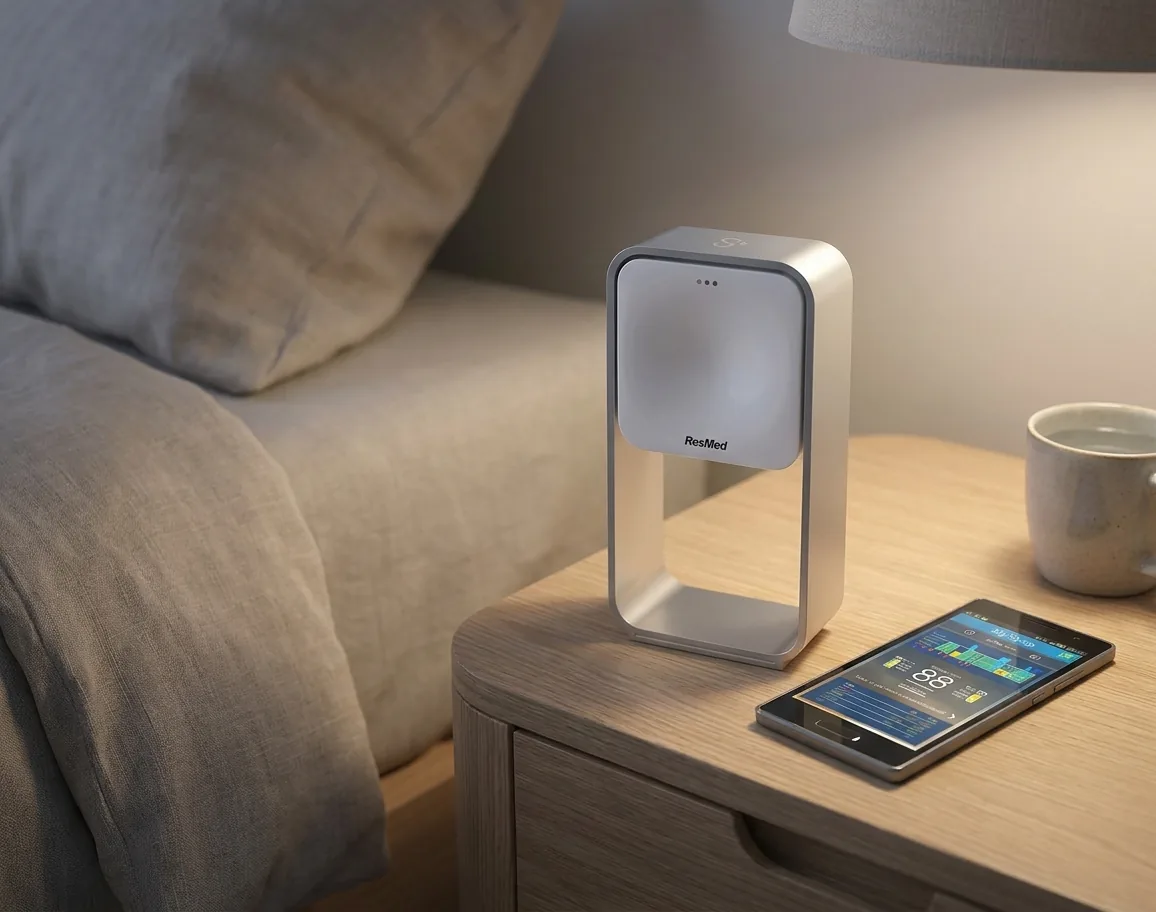
The ResMed S+ sensor standing on a bedside table beside a bed, with a phone next to it showing a night's sleep data.
The S+ on the bedside table, and the phone that carried the night's data.

The hard part

The phone was the data pipe, all night.

The app had to survive until morning on the hardware of the day: small batteries, young Bluetooth, operating systems that killed background work without apology. If the app died at three in the morning, the night's data died with it. That is the quiet hard part of every connected product.

Multiplied across every bedroom.

iOS, Android, tablets. Each platform had its own rules about what an app may do in the dark, and Android meant a fleet of devices that each behaved differently overnight. The promise had to hold on all of them, not on the test bench.

A consumer bar inside a medical company's discipline.

ResMed builds medical devices. Its first consumer product was built with that same seriousness, and it needed to be, because the one thing a consumer never forgives is a missed alarm. A sleep product that costs you a meeting has had its last night on the bedside table.

The research app had to prove something was possible. The product had to keep a promise every single night. Those are different jobs, and the move between them is where this engagement earned its keep.

How we tested the software

Real devices, both platforms.

Purpledecks tested on the hardware people actually owned. Phones and tablets, iOS and Android, overnight, the way the product would actually be used.

The programme's ladder.

Internal releases, then a beta, then a consumer trial before anything went on sale. Our software climbed that ladder with the product.

Written down, specified, verified.

Every requirement was written before it was built, behaviour was checked against what was written, and changes traced back to the requirement they came from. The software was built to IEC 62304, the standard for medical device software, applied here to a consumer product because that is how this client builds.

how we build medical device software

The product went on sale carrying real nights through software that had already spent months being used the way it would be sold: overnight, on real phones, by real people.

Next

A prototype that proves the idea, and a production team that ships it. We do both. Building a connected product, or trying to find out whether one is possible? Talk to the senior engineers who would do the work.

Start a conversation More of our work →

Technical review by Brian Egan, founder, who worked on the build.

Purpledecks is a senior software engineering firm based in Ireland, in the EU, working since 2012. We build and rescue software that has to work.